stay healthy: 100% Pure Garcinia Cambogia Extract with HCA
stay healthy: 100% Pure Garcinia Cambogia Extract with HCA: Q; Where does Garcinia Cambogia Comes from? Grown in India and some parts of Asia for centuries, the Garcinia Cambogia is a fruit that is f...
Sports Research SVETOL Green Coffee Bean Extract is produced from the cherries of the Coffea Arabica tree. We only use SVETOL and our proud of the quality. The "green coffee bean", a natural compound that has less than 2% caffeine and standarized to 45% chlorogenic acids, the active ingredients to help in weight loss and lean mass by controlling glucose and encouraging the body to burn fat.Scientific Research:A recent clinical study (published in a scientific French review, Phytotherapie) carried out on 50 people aged between 19 and 75 years, demonstrated Svetol's Slimming Action thanks to its fat burning effect. Over the course of 60 days, two groups of volunteers, all with a BMI (Body Mass Index) over 25,were observed. The first group was given 400 mg of Svetol daily, whereas the second group received a placebo. After 60 days of supplementation, participants who received Svetol had lost 5.7% of their initial corresponding to an average weight loss of 5 kg or 11 lbs Liquid Softgels:Sports Research offers Green Coffee Bean extract in easy to swallow, liquid softgels. Softgels absorb faster than 2 piece gelatin capsules or pills and are 100% sealed so they are tamper proof and do not decrease in potency like capsules.Sports Research:We use only the highest quality ingredients in our softgels. Our Green Coffee Bean Extract has over 45% Chlorogenic Acids and no artificial ingredients. We use Bioperine (Black Pepper Extract) to naturally enhance absorption to maximize your supplement investment. All of our products are GMO Free, Gluten Free and Soy Free.

100% Pure Garcinia Cambogia Extract with HCA
Q; Where does Garcinia Cambogia Comes from? Grown in India and some parts of Asia for centuries, the Garcinia Cambogia is a fruit that is finally getting noticed by Western nutritionists and diet experts for natural weight loss properties that may unlock easier results for millions of health conscious people seeking to live a healthier lifestyle without any major changes to their present meal plans. Q;How can I be sure Garcinia Cambogia is safe? Sometimes listed under the names Brindle Berry, Malabar Tamarind or as the organic extract compound Hydroxycitric Acid (HCA) - the extract has been thoroughly tested by human history, eaten by many generations of people in the Far East. It has also done exceptionally well in modern clinical studies with absolutely zero known negative side-effects. Q: Who Should Not Take Garcinia Cambogia? As with any diet supplement, pregnant women and children under the age of eighteen should consult with their doctor before starting any new regimen. Patients already taking pharmaceutical medication or in poor health (especially diabetics) should also consult with their physicians to see if they are healthy enough to enjoy the benefits of Pure Garcinia Cambogia before taking it regularly. Q: How Should I Take Garciniav Cambogia? Most Garcinia Cambogia Extract experts suggest taking potassium and calcium along with GCE and starting with a 1000mg regimen. Because this supplement is 'dose dependent' the effect scales up with increased dosage. Also it should always be taken on an empty stomach at least an hour after your most recent meal and at least two hours before your next meal.

stay healthy: Power Foods for the Brain: An Effective 3-Step Pla...
stay healthy: Power Foods for the Brain: An Effective 3-Step Pla...: Product Description Could your breakfast or lunch be harming your memory? Are you missing out on the foods that could prevent Alzhei...
Power Foods for the Brain: An Effective 3-Step Plan to Protect Your Mind and Strengthen Your Memory

Product Description
Could your breakfast or lunch be harming your memory?Are you missing out on the foods that could prevent Alzheimer's disease?
Everyone knows good nutrition supports your overall health, but few realize that certain foods-power foods-can protect your brain and optimize its function, and even dramatically reduce your risk of Alzheimer's Disease.Now, New York Times bestselling author, clinical researcher and health advocate Dr. Neal Barnard has gathered the most up-to-date research and created a groundbreaking program that can strengthen your memory and protect your brain's health.
In this effective 3-step plan Dr. Barnard reveals which foods to increase in your diet and which to avoid, and shows you specific exercises and supplements that can make a difference. It will not only help boost brain health, but it can also reduce your risk of Alzheimer's disease, stroke, and other less serious malfunctions such as low energy, poor sleep patterns, irritability, and lack of focus. You'll discover:
- The best foods to increase cognitive function
- Dairy products and meats-the dangers they may pose to your memory
- The surprising roles alcohol and caffeine play in Alzheimer's risk
- The latest research on toxic metals, like aluminum found in cookware, soda cans, and common antacids.
- Plus a detailed menu plan, recipes and time-saving kitchen tips
Editorial Reviews
Review
"This is a book everyone should read from a doctor whose advice I trust.Power Foods for The Brain will help you maximize your brain power and prevent problems down the road concerning memory loss. Buy it now before you forget to." --Ellen DeGeneres
"Dr. Barnard has written a timely and critically important book on a topic that will be of concern to many people." --T Colin Campbell, PhD, Professor Emeritus, Cornell University, and coauthor, The China Study
"Simple changes to your diet and exercise can help you be at your best when you're young and help prevent memory problems when you're older.Power Foods for the Brain shows you how, step by step. This is an immensely practical and important book." --Dean Ornish, MD, Founder & President of the Preventitive Medicine Research Institute and Clinical Professor of Medicine at University of California, San Francisco
"This is a game changer for anyone concerned with memory or cognition. The great news is that Dr. Barnard has, once again, given us the keys to prevention and profound healing, and those keys are easily accessible." --Kathy Freston
"... simple, effective strategies for preventing dementias-not with drugs, but with great-tasting food and healthy lifestyle choices. Finally, a low-cost, (and delicious) doctor's prescription you will enjoy filling-and one you'll be able to remember to refill, year after year! Given the tsunami of dementias bearing down upon our society, Power Foods for the Brain is, potentially, one of the most important books of the decade." --Michael Klaper, MD, Director, Institute of Nutrition Education and Research, Manhattan Beach, CA
"Enhance your intellect with food. Dr. Barnard's simple dietary prescription also prevents strokes, Alzheimer's disease, and other causes of loss of mental function. The recipes are easy and delicious." --John McDougall, MD, author and founder of the McDougall Program
"Dr. Neal Barnard is one of the most responsible and authoritative voices in American medicine today" --Andrew Weil, MD
About the Author
Neal Barnard, MD is a clinical researcher, author, and health advocate. He is an Adjunct Associate Professor of Medicine at the George Washington University School of Medicine and Health Sciences and president of the nonprofit Physician's Committee for Responsible Medicine. He has been the principal investigator or coinvestigator on several clinical trials investigating the effects of diet on health. He is the author of several books and a frequent lecturer.
"This is a book everyone should read from a doctor whose advice I trust.Power Foods for The Brain will help you maximize your brain power and prevent problems down the road concerning memory loss. Buy it now before you forget to." --Ellen DeGeneres
"Dr. Barnard has written a timely and critically important book on a topic that will be of concern to many people." --T Colin Campbell, PhD, Professor Emeritus, Cornell University, and coauthor, The China Study
"Simple changes to your diet and exercise can help you be at your best when you're young and help prevent memory problems when you're older.Power Foods for the Brain shows you how, step by step. This is an immensely practical and important book." --Dean Ornish, MD, Founder & President of the Preventitive Medicine Research Institute and Clinical Professor of Medicine at University of California, San Francisco
"This is a game changer for anyone concerned with memory or cognition. The great news is that Dr. Barnard has, once again, given us the keys to prevention and profound healing, and those keys are easily accessible." --Kathy Freston
"... simple, effective strategies for preventing dementias-not with drugs, but with great-tasting food and healthy lifestyle choices. Finally, a low-cost, (and delicious) doctor's prescription you will enjoy filling-and one you'll be able to remember to refill, year after year! Given the tsunami of dementias bearing down upon our society, Power Foods for the Brain is, potentially, one of the most important books of the decade." --Michael Klaper, MD, Director, Institute of Nutrition Education and Research, Manhattan Beach, CA
"Enhance your intellect with food. Dr. Barnard's simple dietary prescription also prevents strokes, Alzheimer's disease, and other causes of loss of mental function. The recipes are easy and delicious." --John McDougall, MD, author and founder of the McDougall Program
"Dr. Neal Barnard is one of the most responsible and authoritative voices in American medicine today" --Andrew Weil, MD
About the Author
Neal Barnard, MD is a clinical researcher, author, and health advocate. He is an Adjunct Associate Professor of Medicine at the George Washington University School of Medicine and Health Sciences and president of the nonprofit Physician's Committee for Responsible Medicine. He has been the principal investigator or coinvestigator on several clinical trials investigating the effects of diet on health. He is the author of several books and a frequent lecturer.
Customer Reviews
Most helpful customer reviews162 of 167 people found the following review helpful.
 Worthy read
By Frieda
This is solid, usable, reasonable advice to achieve some important and specific goals, mainly maintaining your brain health as you age. This book discusses Alzheimer's, but also includes a discussion of how to avoid or reverse general cognitive decline and function so you can boost your memory and recall in just a few weeks. The information in the book is science based, well presented, and a pleasant and easy read. Dr. Barnard has a wonderful sense of humor and is able to explain complex subjects clearly without talking down to his reader.
My mother had a stroke a few years ago. When she was recovering, she said her greatest fear was not the possible loss of mobility or discomfort/pain, but the possibility that she might lose her ability to read and work with knitting patterns.
Last year I discovered Dr Barnard's other work and my mother and I went on the diet he outlines in his book 21-Day Kickstart Weight Loss 21-Day Weight Loss Kickstart: Boost Metabolism, Lower Cholesterol, and Dramatically Improve Your Health. I wrote a review of that here: http://www.amazon.com/review/R38EXNJ7X5IP63/ref=cm_srch_res_rtr_alt_1
That diet worked miracles for our health simply by changing our diet. This book will help us extend the benefits of that lifestyle to work miracles for our brain health by showing us what to eat and what to avoid.
Dr. Barnard writes in Power Foods about where brain toxins are found in our diet (interestingly, some of the toxins aren't necessarily things to avoid, but things that are a problem if we ingest either too much or too little, or even the wrong form of, for example, some metals). Dr. Barnard writes that just adding an ounce a day of seeds or nuts (for the proper form of vitamin E) will help reduce the risk of Alzheimers by 70%. Add berries, apples, pears, grapes, green leafy vegetables, and beans to your diet. Certainly things we can all do easily! Also, get rid of saturated fats. We all know we need to to this for heart health, and we need to do it for brain health as well.
The book also describes brain exercises as well as the benefits of physical exercise and gives some specific things to do. Just a half hour three times a week can make a huge difference.
And, very importantly for many of our aging population, what medications can be causing severe damage to our cognition. We found this to be true for my mother. We were able to get her off of her statins from adopting the 21-Day Kickstart diet, and that made a tremendous difference in her ability to think clearly and get rid of the "brain fog" that was following her around like the proverbial dark cloud. We have already made a lot of the changes he suggests in this book, but we are learning some new information to incorporate into our lifestyle, so I would recommend this book even for those who have read other of Dr. Barnard's books.
Finding the root cause of cognitive problems can be quite a riddle to solve. I know it has been with my mother. In this book, Dr. Barnard walks you through the variety of things that can be a problem. One of the important things he noted is that not only can medications impact mental function, and the problems can add up as you add more medications. As we discovered in my family, the doctors did not even consider this while medicating my mother, and we had to do the detective work on medications ourselves. Some of the biggest culprits include sleep medications, statins (cholesterol lowering drugs), anti depressants, allergy meds/antihistamines, anxiety medications, pain killers, blood pressure medications, and antacids. Some of these you can just trade out for another kind, but others you really need to see a doctor about and have it managed properly. Dr. Barnard discusses this and tells you how to address the subject with your doctor. We also called our pharmacist and asked him to take a look at what my mother was taking before we saw the doctor so that we arrived to the appointment as informed as possible.
In addition to medications, Dr Barnard discusses problems that can arise from other areas, such as food intolerances, depression, menopause (this was a big one for me!), thyroid problems, infections, migraines, cancer treatments, diabetes, and more.
There are about 75 recipes in the book. I haven't tried them yet, but they are by the same chef who created the recipes in the Kickstart book, so I expect these to be equally easy to make and quite tasty. Examples of breakfasts include blueberry buckwheat pancakes with veggie sausage and cantaloupe; waffles with maple "bacon;" and breakfast wraps. Examples of lunches include veggie falafel with pita bread and a garden salad; easy colorful pasta salad over mixed greens; English muffin pizza; and a Tuscan wrap. Examples of dinners include red lentil soup with brown rice salad and steamed spinach, tacos with potatoes, swiss chard, and pinto beans with a spinach salad and mashed sweet potato; white bean chili with red rice, steamed spinach, and banana ice cream; and baked ziti with a rainbow salad and strawberry dressing, and warm apple cherry compote. The recipes seem very simple to make without an excessive amount of ingredients or anything excessively costly.
I'd like to briefly address the criticism of Dr Barnard's plan that it can be too restrictive or drastic. It may seem that way with an initial look, but to me, loss of brain function and the prospect of losing mobility, cognition, emotions, and the toll that cognitive degeneration can cause on our families are what's really restrictive and drastic. Being bedridden or institutionalized for our later years is restrictive and drastic. Not remembering our children or being able to experience (or even remember) normal emotions is restrictive and drastic. And in light of those very real and unfortunately not uncommon possibilities, Dr Barnard's suggestions are neither restrictive or drastic.
Speaking as part of a family that started to make some of these changes about a year ago, they aren't initially easy (it can definitely be hard to give up some of the food we have gotten used to), but if you work at it a little bit at a time and just keep trying, it becomes easier and easier as time goes by (the book has a special section to help deal with food cravings and why we have them). It took way less than a year for our taste buds to change and for this way of life to become not only easy for us, but enjoyable.
This book adds to the vast amount of information already out there on the benefits of plant-based diets and is suitable for those who already consider themselves well-read on the subject--there is, of course, some information you will have already heard, but there is more information that is new and important and not available from other mainstream sources.
Thank you for reading my review. This is an important topic and I know it's hard for some people to think about some of the changes Dr. Barnard suggests. But it's very do-able.
53 of 56 people found the following review helpful.
Practical Advise that Will Change Your Brain and LifeBy Karen Murphy
I saw Dr. Barnard speak in California last year about how specific foods can help protect the mind, improve the memory, and prevent Alzheimer's. It was fascinating, and I have been waiting for this book ever since. He has a very straightforward style, and I like the way he bases everything on scientific research, but at the same time keeps it simple and practical. I also like the fact that he focuses on food. Everyday choices, not pills.
51 of 56 people found the following review helpful.
Wonderful read with advice I can use right awayBy C.J.
This is the first book to really show how to eat to protect your brain, and I am delighted that it is finally available. My grandparents had severe memory problems and so I looked everywhere for reliable advice, but the only books I could find wanted to push supplements or medications, and none of that was any use. Dr. Barnard has a completely different approach, based on food, and I'm putting it to work as of now.
See all 33 customer reviews...
The Healthy Green Drink Diet: Advice and Recipes to Energize, Alkalize, Lose Weight, and Feel Great
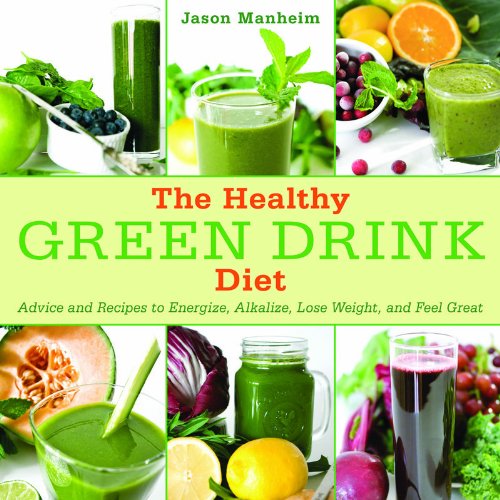
Product Description
Celebrities, models, and nutritionists to the stars are all about the "green" drink—here's how to enjoy them at home.
One juice or smoothie a day—made from green vegetables such as kale, cucumber, celery, and spinach—works wonders for organ health, immune system strength, and weight loss. Now the founder of heathygreendrink.com offers a persuasive argument for adding a green drink to your day, as well as recipes for dozens of different variations.
Why drink green?
•Green leafy vegetables are extremely alkaline and great for lowering your blood pH and remedying many common ailments and diseases.
•By juicing or blending the vegetables into a delicious smoothie, you can enjoy the goodness of many more cups of greens that you could possibly eat in one sitting.
•The juicing process also breaks down or removes the fibers of the plants so their nutrients are able to get into your system quicker.
•The “green drink” approach offers dieters the chance to add something rather than take it away, without guilt.
A cleansing detox drink is a fantastic, tasty way to consume all your necessary vitamins and minerals without having to resort to a processed multivitamin. Plus, green-drinkers quickly start to crave more fruits and vegetables, leading them to a healthier diet over all. The Healthy Green Drink Diet gives health enthusiasts all the tools they need to add green drinks to their daily routine and feel the wonderful, energizing results through and through.
80 color illustrations
Editorial Reviews
About the Author
Jason Manheim created and runs the website healthygreendrink.com. A website developer and designer, he began making green drinks six years ago and has felt great ever since. He lives in Los Angeles, California.
Jason Manheim created and runs the website healthygreendrink.com. A website developer and designer, he began making green drinks six years ago and has felt great ever since. He lives in Los Angeles, California.
Customer Reviews
Most helpful customer reviews466 of 475 people found the following review helpful.
Good GREEN! ...and a couple of warningsBy Joanna Daneman
I love to juice vegetables and fruits and I have a good friend who literally dragged himself off Death's Door by juicing vegetables that allowed him to heal up from an obesity-caused ailment. I can't think of any better endorsement than that. While it is easy to juice fruits and carrots and cucumbers, greens add a lot more to a healthy mixture and also allow you to eat MORE servings of those deep green vegetables as well as change the balance of your body to a more healthful one.
The author gives you advice on how to make green drinks, which do not necessarily require a juicer, in fact, he informs us that blending (breaking down cell walls of the veg) and triturating juicers do a better job and get you more nutrients (one brand of triturating juicer is the Omega, which I always recommend to my friends. It is listed as a "masticating" but it is also called triturating.) So you actually don't have to have a juicer, per se for this book. A blender can work.
The recipes show you how to incorporate arugula (rocket), kale, collards, other greens and make digestible, nutrient filled and tasty smoothies that can add buckets of vegetables with all their vitamins, minerals and antioxidants to your daily diet. I have an issue that I do not eat enough vegetables, especially raw ones as I don't like salads when I go out to eat (bagged salads as served nowadays in most places absolutely bore me, like eating leathery, tasteless shrubbery) and I don't use them up fast enough at home. Juicing and green smoothies are actually for me, convenient as well as healthy.
In addition to showing you how to use these green, you get some info on why lemon is alkalizing to the body and why reducing an acid balance (which is typical if you eat a meat and sweet diet) is helpful for weight loss, healing and general health. The recipes here are good--you learn how to use fresh basil, lemons, and other ingredients such as berries to make something that looks perhaps like pond scum but tastes refreshing and delicious. (JUST CLOSE YOUR EYES!!!)
Some warnings; if you have thyroid disease, kale and other cabbage relatives may provoke a reaction (swelling) if you consume them. I cannot drink even one handful of kale juice without feeling it the next day. Listen to your body. I love kale and collards but I am forced to avoid all cabbages, sad to say. And parsley, which I always include in a small, loose, golf-balled sized amount (maybe less than a quarter cup) is toxic in large quantities. So if you get into juicing big time and love parsley, you need to be careful. There can be too much of a good thing. And an additional warning; if you take certain blood thinners, adding a large amount of greens adds more Vitamin K to your system and that affects how the blood thinners work; Vitamin K is involved in the clotting biochemistry of the body. So before you embark on juicing greens, talk to your doctor if you are taking thinners.
Notes on the Kindle Edition: I like Kindle books for subjects such as this--recipes and facts are convenient in Kindle format. But there are too many photos in black and white--pages of them. The regular Kindle displays only black and white so the photos are less than appealing and pretty much useless- I know what arugula looks like and a glass of smoothie is a glass of smoothie without color to show off. I'd suggest you not get the Kindle version unless you just want recipes, because it's annoying to have to page past a lot of photos.
485 of 516 people found the following review helpful.
 Nice picture book - BUT not much else
By Green Smoothie Junkie
I am a professed green smoothie junkie and have been teaching about them for nearly 9 years. I collect information, books and recipes on green drinks. Naturally I had to get this one. I'm not much of an Amazon reviewer but felt compelled to share my thoughts since so many people have brought this book to my attention and have asked me about it.
In a nutshell - this is a beautiful picture book, well presented BUT very thin in content and new information.
I applaud Jason for making such a beautiful book. Anything published about green smoothies to get the info out ranks high in my book. Unfortunately the book reads like a website. In fact, pretty much all of the information and recipes presented in the book can be found on any single reputable website about green smoothies. I found myself thinking... this is identical to x website as well as y website and z and... If I'm going to spend money on a book I want there to be substance - at least something new that I can't easily read on a website.
Another issue I have with the book is that it is clearly geared towards green smoothie beginners, which is great, but many recipes are unusual and targeted for specific tastes. In other words they don't embody the spirit of the beginner to support them with simplicity to actually like drinking greens when they are not used to it. While I do enjoy many of the recipes I would not recommend the majority of them for those new to green drink. It also promises to deliver every health benefit possible about green smoothies but again, gives only a cursory overview of what it's really about.
Basically, if you are brand new to green drinks, don't have any other book on them, are not timid about trying green drinks and do not surf the web to learn about them, then this is a nice book to start on. There are so many better books about green smoothies/drinks in the $10 range and eBooks for under $3. If you do spend time learning on the internet (which is likely since you are doing so at this moment) then access the identical information for free on the myriad of green smoothie websites out there.
Whether you get this book or not, just be sure to drink your green drinks!
40 of 41 people found the following review helpful.
Best for BeginnersBy SuzeQ2U
I wanted new ideas for making green smoothies/juices and purchased this book after reading some of the excerpts online. After receiving it, I found that the introduction part is misleading. The author mentions that people new to green smoothies/drinks favor large amounts of fruit and only a small amount of greens, but that people should transition to a larger greens-to-fruit ratio. He implies that his recipes will have more greens than what beginners like, but they do not. The majority of the recipes are mainly fruit with only a small portion of greens added.
I also thought it was interesting in the introduction that the author mentions adding some pumpkin puree to his smoothies and that he uses it just about every day. This was a new idea for me, so I was hoping he would have many recipes using pumpkin, but there is only one in the book. Does this mean he has the same smoothie every day? So much for wanting variety, I guess.
There are nice pictures in the book, but the recipes have too much fruit and too little greens for me. There is also no nutritional information or serving sizes for the recipes. This may not have been possible since some of the ingredient amounts are vague, but it would have been nice to have.
Bottom line, this is definitely geared toward people new to green smoothies and juices. If this was my first green smoothie/juice book, I may have been happy with it, too. For anyone wanting more smoothie and juice choices, I would rather recommend The Big Book of Juices: More Than 400 Natural Blends for Health and Vitality Every Day by Natalie Savona, either version (with or without pictures). It has many creative ideas for flavor combinations and is the main book I use.
The FastDiet: Lose Weight, Stay Healthy, and Live Longer with the Simple Secret of Intermittent Fasting

Product Description
The official US edition of the international bestseller—containing US measurements and a month's worth of meals in color.Is it possible to eat normally, five days a week, and become slimmer and healthier as a result?
Simple answer: yes. You just limit your calorie intake for two nonconsecutive days each week—500 calories for women, 600 for men. You’ll lose weight quickly and effortlessly with the FastDiet.
Scientific trials of intermittent fasters have shown that it will not only help the pounds fly off, but also reduce your risk of a range of diseases from diabetes to cardiovascular disease and even cancer. “The scientific evidence is strong that intermittent fasting can improve health,” says Dr. Mark Mattson, Chief of the Laboratory of Neurosciences, National Institute on Aging, and Professor of Neuroscience, Johns Hopkins University.
This book brings together the results of new, groundbreaking research to create a dietary program that can be incorporated into your busy daily life, featuring:
• Forty 500- and 600-calorie meals that are quick and easy to make
• 8 pages of photos that show you what a typical “fasting meal” looks like
• The cutting-edge science behind the program
• A calorie counter that makes dieting easy
• And much more.
Far from being just another fad, the FastDiet is a radical new way of thinking about food, a lifestyle choice that could transform your health. This is your indispensable guide to simple and effective weight loss, without fuss or the need to endlessly deprive yourself.
Editorial Reviews
Review
About the Author
Dr. Michael Mosley is a British journalist, producer, and TV presenter.
Excerpt. © Reprinted by permission. All rights reserved.
So is there a different evidence-based approach? One that relies on science, not opinion? Well, we think there is: intermittent fasting.
There is nothing else you can do to your body that is as powerful as fasting.
When we first read about the alleged benefits of intermittent fasting, we, like many, were skeptical. Fasting seemed drastic, difficult—and we both knew that dieting of any description is generally doomed to fail. But now that we’ve looked at it in depth and tried it ourselves, we are convinced of its remarkable potential. As one of the medical experts interviewed for this book puts it: “There is nothing else you can do to your body that is as powerful as fasting.”
Fasting, of course, remains an article of faith for many. The fasts of Lent, Yom Kippur, and Ramadan are just some of the better-known examples. Greek Orthodox Christians are encouraged to fast for 180 days of the year (according to Saint Nikolai of Zicha, “Gluttony makes a man gloomy and fearful, but fasting makes him joyful and courageous”), while Buddhist monks fast on the new moon and full moon of each lunar month.
Many more of us, however, seem to be eating most of the time. We’re rarely ever hungry. But we are dissatisfied. With our weight, our bodies, our health.
Intermittent fasting can put us back in touch with our human selves. It is a route not only to weight loss, but also to long-term health and well-being. Scientists are only just beginning to discover and prove how powerful a tool it can be.
This book is a product of those scientists’ cutting-edge investigations and their impact on our current thinking about weight loss, disease resistance, and longevity. But it is also the result of our personal experiences.
Both are relevant here—the lab and the lifestyle—so we investigate intermittent fasting from two complementary perspectives. First, Michael, who used his body and medical training to test its potential, explains the scientific foundations of intermittent fasting (IF) and the 5:2 diet—something he brought to the world’s attention during the summer of 2012.
Then Mimi offers a practical guide on how to do it safely, effectively, and in a sustainable way, a way that will fit easily into your normal everyday life. She looks in detail at how fasting feels, what you can expect from day to day, what to eat, and when to eat, and provides a host of tips and strategies to help you gain the greatest benefit from the diet’s simple precepts.
As you’ll see below, the FastDiet has changed both of our lives. We hope it will do the same for you.
While making a documentary for the BBC, I was fortunate enough to have an MRI (magnetic resonance imaging) scan done. This revealed that I am a TOFI—thin on the outside, fat inside. This visceral fat is the most dangerous sort of fat, because it wraps itself around your internal organs and puts you at risk for heart disease and diabetes. I later had blood tests that showed I was heading toward diabetes, and had a cholesterol score that was also way too high. Obviously, I was going to have to do something about this. I tried following standard advice, except it made little difference. My weight and blood profile remained stuck in the “danger ahead” zone.
I had never tried dieting before because I’d never found a diet that I thought would work. I’d watched my father try every form of diet, from Scarsdale through Atkins, from the Cambridge Diet to the Drinking Man’s Diet. He’d lost weight on each one of them, and then within a few months put it all back on, and more.
Then, at the beginning of 2012, I was approached by Aidan Laverty, editor of the BBC science series Horizon, who asked if I would like to put myself forward as a guinea pig to explore the science behind life extension. I wasn’t sure what we would find, but along with producer Kate Dart and researcher Roshan Samarasinghe, we quickly focused on calorie restriction and fasting as a fruitful area to explore.
Calorie restriction (CR) is pretty brutal; it involves eating an awful lot less than a normal person would expect to eat, and doing so every day of your (hopefully) long life. The reason people put themselves through this is because it is the only intervention that has been shown to extend lifespan, at least in animals. There are at least 10,000 CRONies (Calorie Restriction with Optimum Nutrition) worldwide, and I have met quite a number of them. Despite their generally fabulous biochemical profile, I have never been seriously tempted to join their skinny ranks. I simply don’t have the willpower or desire to live permanently on an extreme low-calorie diet.
So I was delighted to discover intermittent fasting (IF), which involves eating fewer calories, but only some of the time. If the science was right, it offered the benefits of CR but without the pain.
I set off around the United States, meeting leading scientists who generously shared their research and ideas with me. It became clear that IF was no fad. But it wouldn’t be as easy as I’d originally hoped. As you’ll see later in the book, there are many different forms of intermittent fasting. Some involve eating nothing for twenty-four hours or longer. Others involve eating a single, low-calorie meal once a day, every other day. I tried both but couldn’t imagine doing either on a regular basis. I found it was simply too hard.
Instead I decided to create and test my own modified version. Five days a week, I would eat normally; on the remaining two I would eat a quarter of my usual calorie intake (that is, 600 calories).
I split the 600 calories in two—around 250 calories for breakfast and 350 calories for supper—effectively fasting for around twelve hours at a stretch. I also decided to split my fasting days: I would fast on Mondays and Thursdays. I became my own experiment.
The program, Eat, Fast, Live Longer, which detailed my adventures with what we were now calling the 5:2 diet, appeared on the BBC during the London Olympics in August 2012. I expected it to be lost in the media frenzy that surrounded the Games, but instead it generated a frenzy of its own. The program was watched by more than 2.5 million people—a huge audience for Horizon—and hundreds of thousands more on YouTube. My Twitter account went into overdrive, my followers tripled; everyone wanted to try my version of intermittent fasting, and they were all asking me what they should do.
The newspapers took up the story. Articles appeared in The Times (London), the Daily Telegraph, the Daily Mail, and the Mail on Sunday. Before long, it was picked up by newspapers all over the world—in New York, Los Angeles, Paris, Madrid, Montreal, Islamabad, and New Delhi. Online groups were created, menus and experiences swapped, chat rooms started buzzing about fasting. People began to stop me on the street and tell me how well they were doing on the 5:2 diet. They also e-mailed details of their experiences. Among those e-mails, a surprisingly large number were from doctors. Like me, they had initially been skeptical, but they had tried it for themselves, found that it worked, and had begun suggesting it to their patients. They wanted information, menus, details of the scientific research to scrutinize. They wanted me to write a book. I hedged, procrastinated, then finally found a collaborator, Mimi Spencer, whom I liked and trusted and who has an in-depth knowledge of food. Which is how what you are reading came about.
As a presenter I have made a dozen series for ...
About the Author
Dr. Michael Mosley is a British journalist, producer, and TV presenter.
Excerpt. © Reprinted by permission. All rights reserved.
Introduction
OVER THE LAST FEW DECADES, FOOD FADS HAVE come and gone, but the standard medical advice on what constitutes a healthy lifestyle has stayed much the same: eat low-fat foods, exercise more . . . and never, ever skip meals. Over that same period, levels of obesity worldwide have soared.So is there a different evidence-based approach? One that relies on science, not opinion? Well, we think there is: intermittent fasting.
There is nothing else you can do to your body that is as powerful as fasting.
When we first read about the alleged benefits of intermittent fasting, we, like many, were skeptical. Fasting seemed drastic, difficult—and we both knew that dieting of any description is generally doomed to fail. But now that we’ve looked at it in depth and tried it ourselves, we are convinced of its remarkable potential. As one of the medical experts interviewed for this book puts it: “There is nothing else you can do to your body that is as powerful as fasting.”
Fasting: An Ancient Idea, a Modern Method
Fasting is nothing new. As we’ll discover in the next chapter, your body is designed to fast. We evolved at a time when food was scarce; we are the product of millennia of feast or famine. The reason we respond so well to intermittent fasting may be because it mimics, far more accurately than three meals a day, the environment in which modern humans were shaped.Fasting, of course, remains an article of faith for many. The fasts of Lent, Yom Kippur, and Ramadan are just some of the better-known examples. Greek Orthodox Christians are encouraged to fast for 180 days of the year (according to Saint Nikolai of Zicha, “Gluttony makes a man gloomy and fearful, but fasting makes him joyful and courageous”), while Buddhist monks fast on the new moon and full moon of each lunar month.
Many more of us, however, seem to be eating most of the time. We’re rarely ever hungry. But we are dissatisfied. With our weight, our bodies, our health.
Intermittent fasting can put us back in touch with our human selves. It is a route not only to weight loss, but also to long-term health and well-being. Scientists are only just beginning to discover and prove how powerful a tool it can be.
This book is a product of those scientists’ cutting-edge investigations and their impact on our current thinking about weight loss, disease resistance, and longevity. But it is also the result of our personal experiences.
Both are relevant here—the lab and the lifestyle—so we investigate intermittent fasting from two complementary perspectives. First, Michael, who used his body and medical training to test its potential, explains the scientific foundations of intermittent fasting (IF) and the 5:2 diet—something he brought to the world’s attention during the summer of 2012.
Then Mimi offers a practical guide on how to do it safely, effectively, and in a sustainable way, a way that will fit easily into your normal everyday life. She looks in detail at how fasting feels, what you can expect from day to day, what to eat, and when to eat, and provides a host of tips and strategies to help you gain the greatest benefit from the diet’s simple precepts.
As you’ll see below, the FastDiet has changed both of our lives. We hope it will do the same for you.
Michael’s Motivation: A Male Perspective
I am a 55-year-old male, and before I embarked on my exploration of intermittent fasting, I was mildly overweight: at five feet, eleven inches, I weighed around 187 pounds and had a body mass index of 26, which put me into the overweight category. Until my midthirties, I had been slim, but like many people I then gradually put on weight, around one pound a year. This doesn’t sound like much, but over a couple of decades it pushed me up and up. Slowly I realized that I was starting to resemble my father, a man who struggled with weight all his life and died in his early seventies of complications associated with diabetes. At his funeral many of his friends commented on how like him I had become.While making a documentary for the BBC, I was fortunate enough to have an MRI (magnetic resonance imaging) scan done. This revealed that I am a TOFI—thin on the outside, fat inside. This visceral fat is the most dangerous sort of fat, because it wraps itself around your internal organs and puts you at risk for heart disease and diabetes. I later had blood tests that showed I was heading toward diabetes, and had a cholesterol score that was also way too high. Obviously, I was going to have to do something about this. I tried following standard advice, except it made little difference. My weight and blood profile remained stuck in the “danger ahead” zone.
I had never tried dieting before because I’d never found a diet that I thought would work. I’d watched my father try every form of diet, from Scarsdale through Atkins, from the Cambridge Diet to the Drinking Man’s Diet. He’d lost weight on each one of them, and then within a few months put it all back on, and more.
Then, at the beginning of 2012, I was approached by Aidan Laverty, editor of the BBC science series Horizon, who asked if I would like to put myself forward as a guinea pig to explore the science behind life extension. I wasn’t sure what we would find, but along with producer Kate Dart and researcher Roshan Samarasinghe, we quickly focused on calorie restriction and fasting as a fruitful area to explore.
Calorie restriction (CR) is pretty brutal; it involves eating an awful lot less than a normal person would expect to eat, and doing so every day of your (hopefully) long life. The reason people put themselves through this is because it is the only intervention that has been shown to extend lifespan, at least in animals. There are at least 10,000 CRONies (Calorie Restriction with Optimum Nutrition) worldwide, and I have met quite a number of them. Despite their generally fabulous biochemical profile, I have never been seriously tempted to join their skinny ranks. I simply don’t have the willpower or desire to live permanently on an extreme low-calorie diet.
So I was delighted to discover intermittent fasting (IF), which involves eating fewer calories, but only some of the time. If the science was right, it offered the benefits of CR but without the pain.
I set off around the United States, meeting leading scientists who generously shared their research and ideas with me. It became clear that IF was no fad. But it wouldn’t be as easy as I’d originally hoped. As you’ll see later in the book, there are many different forms of intermittent fasting. Some involve eating nothing for twenty-four hours or longer. Others involve eating a single, low-calorie meal once a day, every other day. I tried both but couldn’t imagine doing either on a regular basis. I found it was simply too hard.
Instead I decided to create and test my own modified version. Five days a week, I would eat normally; on the remaining two I would eat a quarter of my usual calorie intake (that is, 600 calories).
I split the 600 calories in two—around 250 calories for breakfast and 350 calories for supper—effectively fasting for around twelve hours at a stretch. I also decided to split my fasting days: I would fast on Mondays and Thursdays. I became my own experiment.
The program, Eat, Fast, Live Longer, which detailed my adventures with what we were now calling the 5:2 diet, appeared on the BBC during the London Olympics in August 2012. I expected it to be lost in the media frenzy that surrounded the Games, but instead it generated a frenzy of its own. The program was watched by more than 2.5 million people—a huge audience for Horizon—and hundreds of thousands more on YouTube. My Twitter account went into overdrive, my followers tripled; everyone wanted to try my version of intermittent fasting, and they were all asking me what they should do.
The newspapers took up the story. Articles appeared in The Times (London), the Daily Telegraph, the Daily Mail, and the Mail on Sunday. Before long, it was picked up by newspapers all over the world—in New York, Los Angeles, Paris, Madrid, Montreal, Islamabad, and New Delhi. Online groups were created, menus and experiences swapped, chat rooms started buzzing about fasting. People began to stop me on the street and tell me how well they were doing on the 5:2 diet. They also e-mailed details of their experiences. Among those e-mails, a surprisingly large number were from doctors. Like me, they had initially been skeptical, but they had tried it for themselves, found that it worked, and had begun suggesting it to their patients. They wanted information, menus, details of the scientific research to scrutinize. They wanted me to write a book. I hedged, procrastinated, then finally found a collaborator, Mimi Spencer, whom I liked and trusted and who has an in-depth knowledge of food. Which is how what you are reading came about.
Michael’s Background
I trained as a doctor at the Royal Free Hospital in London, and after passing my medical exams, I joined the BBC as a trainee assistant producer. Over the last twenty-five years, I have made numerous science and history documentaries for the BBC, first behind the camera, more recently in front. I was executive producer of QED; Trust Me, I’m a Doctor; and Superhuman. I worked with John Cleese, Jeremy Clarkson, Professor Robert Winston, Sir David Attenborough, and Professor Alice Roberts. I devised and executive-produced many programs for the BBC and the Discovery Channel, including:Pompeii: The Last Day, Supervolcano, and Krakatoa: Volcano of Destruction.As a presenter I have made a dozen series for ...
Customer Reviews
Most helpful customer reviews404 of 412 people found the following review helpful.
Revolutionary Weight Loss Method!By Lee Mellott
There are many ways to lose weight from counting point to micro-managing carbs. But almost all of them involve eating less calories on a daily basis. The result - you lose weight but let's face it the prospect of eating less every day gets old. And in many cases weight that is shed is quickly put back on.
Enter Dr. Michael Mosley with "The Fast Diet". Dr. Mosley a science researcher, investigated how fasting can result in enormous benefits such as increased longevity, lower blood pressure, improved cholesterol and much more. He presented his findings in the British television BBC special documentary "Horizon: Eat, Fast and Live Longer".
Instead of a pure fast Dr. Mosley found that you could enjoy many benefits from eating a reduced calorie diet just 2 days a week and eating normally the other 5. For women about 500 calories and for men about 600 on the 2 lower calorie days. Based on the documentary thousands of British people tried eating this way and found it to be fast, effective and much easier than a traditional diet.
In the book, "The Fast Diet", Dr. Mosley presents the science behind how and why the diet works. His co-author Mini Spencer shares menu plans and tips to make the plan user friendly. The book also includes color photographs so you get a feel for what a low calorie day looks like. And there are inspirational accounts from people who are using the diet, losing weight and enjoying greater health and renewed vitality.
A typical 500 calorie day on the plan might include a small apple, small mango and small boiled egg (223 calories) for breakfast and a tuna, bean and garlic salad for dinner (267 calories). Or you could spread your calories between lunch and dinner or eat them at one main meal. The plan is very flexible. The days you are not on the plan you eat normally, including high fat foods, without counting calories. You might think that on the feed days people would go crazy but research has shown that people eat only a little more than what they would normally eat. Knowing that you can have pretty much what you like most days of the week makes sticking to the plan so much easier than traditional diets.
Based on the documentary (before the book was released in the U.S.) I decided to try the plan making up simple 500 calorie meals and I was amazed at how much easier it is than traditional dieting. Variations of the plan are easy to do also such as every other day, 4:3 etc. And if you miss a day you simply get back on track the next. On fast days, I like to go as far into the day as possible without eating so I have a cup of espresso in the morning, an egg on sandwich thin with berries around noon, small snack mid-afternoon and a protein with veggies for dinner. It has been surprisingly easy to do. I dropped 5 pounds fast!
The benefits of following 5:2 are huge from what we can see visually i.e. weight loss to what we can't i.e. our bodies inner workings. And best of all many find that it is so much easier to diet just a couple days a week than every day. You really do get used to it. Once you have achieved your desired body weight you can adjust the plan to one day a week if desired or eat a few more calories on the diet days.
Side note - I purchased the Kindle version of the book and the formatting is excellent. The menu plan is hyper-linked to the recipes and the color photos are clear.
Overall if you are struggling with traditional diets and want to improve your health, this book, "The Fast Diet" gets my highest recommendation!
290 of 321 people found the following review helpful.
 Try the diet, skip the book
By D. Farina
The 5:2 diet plan is pretty simple, two days a week you keep your calories to a minuscule 500/600 per day and the rest of the week eat normally. The author claims that a) you will lose weight and b) it will dramatically improve your long term health.
Let me address the first part. I have been trying the diet for a couple of weeks and it has been working for me. I am one of those people that has that stubborn last 10-15 pounds to lose and I have made more progress, down about 8 lbs since trying the diet. I find the diet really easy to follow, basically 2 days a week I watch what I eat and keep to the 600 calories. On those days, I drink more coffee and tea then usual to keep myself from eating, but once resigned to a fast day, basically you just have to make it through the day. I pick Mondays because they stink anyhow and one other day. Oddly, once you get used to it, the fasting is really no big deal. I get hungry a couple times a day and it is amazing a cup of green tea and the hunger goes away. While 600 calories is not a lot, it is enough to function, work and workout without any difficulties.
I do truly believe that this plan will work for me long term as I consider it more of a strategy then a diet. (The strategy concept was in the book.) Basically, I need to cut my calories down and was not very good at knocking off 500 calories a day for a week by eating slightly less. So this I think will work for me. (I will circle back in a month with a weight update.)
Moving to the book. I have two issues with the book. The plan is so blazingly simple (which may be part of its appeal) that you really don't need a book. Cut your calories to 500/600 per week twice a week and that is what you do. Once you get your goal weight go to one day a week. If you start gaining weight back go back to 2 days. That is pretty much it, not sure why it takes more than a page or two to explain. Heck I just explained it in 2 sentences. Dieting is not rocket science, people need to eat less and burn more to lose weight. This is one simple strategy for eating less.
My second complaint about the book is that it has all sorts of medical claims. The reality is that the diet is too new and the claims are not supported by hard scientific evidence in my view. The book is full of anecdotal evidence from people who have been on the diet and also from some studies about fasting. Not what I call hard science. I have a lot of trouble believing all the fantastic medical claims that the book put forward. I am not saying that they are not true, but what I am saying is it is too early and there is too little data.
In conclusion, I just don't see any point to the book. There are plenty of articles out there on the diet, and getting started is really simple, the book in my view didn't add enough value for me to justify the price and time I spent reading it.
177 of 199 people found the following review helpful.
This is it!By DAVID J HARROP
I've never written a review before, but after trying the Fast Diet for almost 2 months, I felt compelled to share my experience. I've tried them all, from Atkins to Zone & everything in-between, but I feel like I've finally found an eating plan I'll be following for life.
I didn't have a huge amount of weight to lose. But I felt uncomfortable in my favourite jeans & I didn't need scales to know I was starting to pile it on - again. So I started following Dr Mosley's Fast Diet after watching the BBC documentary 'Eat, Fast & Live Longer'. The Fast Days felt weird at first. I imagined I'd probably collapse in a heap half-way through the day, or start nibbling on my arm; but it's really not so bad. Hunger isn't a death sentence; it's just for today. You don't wake up ravenously hungry, but everything tastes incredible.
Fast Days feel quite normal now. I usually don't eat anything before 3pm, I just drink water & tea/coffee. Then I may have oatmeal & raisins, or fruit. A late dinner may be chicken & vegetables. I even regularly save 100 calories for a drink or two. As I said, I didn't have a lot of weight to lose, but despite going on a long vacation & really enjoying my 'feast days', I'm at least 3kg's lighter, my 501's I've had since the '90's fit like a glove, & it all feels fairly effortless.
The book is well worth buying, even if you've seen the documentary. It answers any questions you may have, & Mimi Spencer's input & advice & Meal Plans are useful. I'm not sure why some other reviewers experienced problems with the Kindle edition; I've got the original cheap model, & the format is excellent.
If even half of Dr Mosley's claims are true, such as lower blood pressure, lower risk of cardiovascular disease, diabetes & some cancers etc, then the Fast Diet is what we've all been waiting for, & weight loss is just the icing on the cake.
Subscribe to:
Posts (Atom)